

Preparing for family counseling in Ohio doesn’t have to feel overwhelming. It’s mostly about logistics and expectations. There’s no script, or specific list of grievances you need to keep from the last few years. But you do need a clear sense of what you want to change and a basic understanding of how your hour session will go.
Mason Family Counseling offers same-week appointments and instant insurance verification to make things easy for you. There’s no excuse to not get the counseling support you need.
The best thing you can do before your first session is to set a specific goal or two. It works as a simple checklist to help you communicate with your family.
Key Takeaways
- Check insurance coverage and session costs before your first visit.
- Define one or two practical goals your family wants to achieve.
- Frame the session as a “team meeting” to kids and teens.
- Choose between in-person sessions in Mason or telehealth across Ohio.
- Expect a structured plan from your therapist by the end of session one.
What Family Counseling Actually Looks Like in Ohio
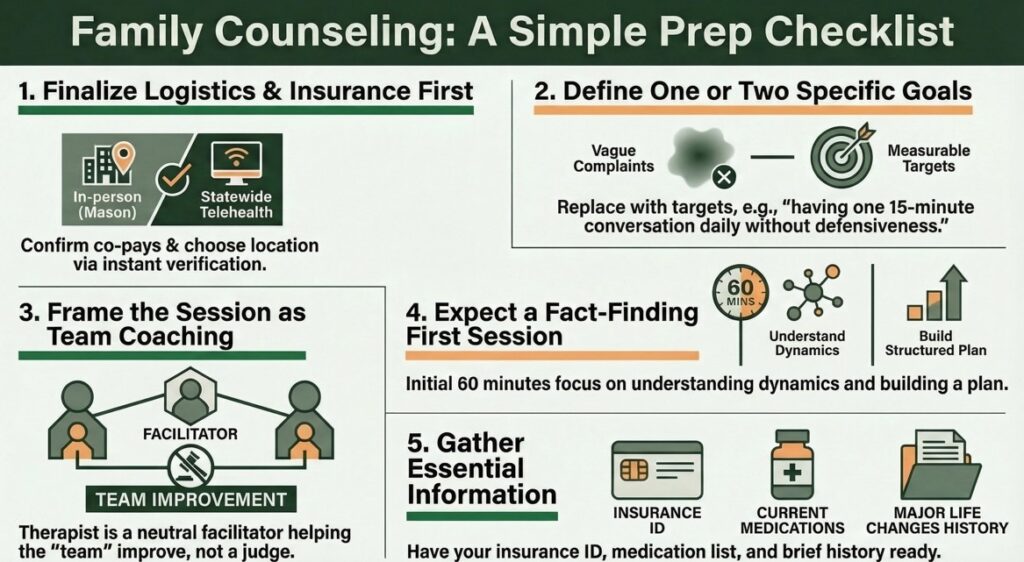
In your first session, the therapist acts as a neutral facilitator rather than a judge. You will spend sixty minutes discussing your family’s current dynamics and history. The goal is for everyone to feel heard while the therapist identifies patterns and helps you build a practical plan for improvement.
The first session is essentially a fact-finding mission. The therapist needs to understand the “system” of your family. They are looking at how you communicate, where the friction points are, and what has already been tried. Do not expect a total transformation in sixty minutes. Do expect to leave with a clearer understanding of the steps required to get there.
Before You Book: Practical Steps to Get Ready
Before you ever sit down for marriage and family therapy, or an adolescent session in Mason, there are administrative hurdles that can stall your progress. We treat these logistics as part of the care because administrative friction keeps people stuck.
Verify Your Insurance and Logistics First
Nothing kills the momentum of seeking help like a surprise bill or a three-month waitlist. You are likely managing a full schedule and a household budget. You need to know that this service fits into both.
At Mason Family Counseling, we verify your insurance instantly. This means you know your co-pay and deductible responsibilities before you walk through the door. If you are using a plan from a major employer like P&G or Kroger, or a provider like Anthem, we make sure those details are settled. Knowing the cost upfront allows you to focus on the actual therapy.
Choose the Right Format: In-Person or Telehealth
Consider what will actually work for your family’s schedule. If you live in Mason or West Chester, an in-person visit might feel more grounded. For busy professionals or families spread across the state, telehealth is often the more practical choice.
Mason Family Counseling has two convenient locations to serve Southwest Ohio and the greater Cincinnati area.
Telehealth removes the commute and the stress of getting everyone to the same physical location. It allows your family to engage from the comfort of home. If being in a neutral, professional office helps your family stay focused, our Mason locations are designed for that. Choose the path of least resistance. The goal is to show up consistently.
Not sure what your plan covers? We verify insurance instantly so there are no surprises on day one. Check your coverage at our contact us page.
How to Prepare Each Family Member (Including Yourself)
The hardest part of preparation is often the “buy-in.” You are likely the one doing the research and making the call. Now you have to convince a skeptical teen or a reluctant spouse that this is a good use of their time.
Talking to Kids or Teens Without Overpromising
Do not tell your children you are going to see a “friend” or that you are just “going for a drive.” Be direct. Kids and teens value honesty, even if they are frustrated by the situation.
Frame the appointment as a way to make the house feel more peaceful. You might say: “We have been arguing a lot lately, and I want our home to feel better for everyone. We are going to talk to a professional who helps families learn how to listen and solve problems together.”
Avoid making the therapist out to be a principal or a judge who will “fix” their behavior. This isn’t about getting them in trouble. It is about improving the team.
Getting a Reluctant Spouse or Partner On Board
If your partner is skeptical, they probably fear that therapy will be an endless, unproductive loop of “how does that make you feel?”
Address that fear directly. Explain that you chose a practice that focuses on evidence-based tools and practical plans. Tell them: “This isn’t an open-ended exploration of the past. It is a defined engagement with measurable outcomes. We are going to get tools we can use starting on day one.”
Focus on the efficiency of the process. If they know there is a beginning, a middle, and an end, they are much more likely to participate.
What to Bring and What to Think About Beforehand
Use this section as your checklist. You do not need to over-prepare, but having these items ready will help you hit the ground running.
The Preparation Checklist
- Insurance Information: Have your card or digital ID ready.
- A List of Current Medications: This is important if you are considering medication management alongside counseling.
- One Clear Goal: What is the single most important thing that needs to change?
- A Brief History: Think about recent major life changes (moves, job losses, deaths, or school transitions).
- Questions for the Therapist: Ask about their experience with your specific issue or their approach to family systems.
Self-Check: Is Your Family Ready?
Answer these five questions to gauge your starting point:
- Can we agree on one specific problem we want to solve? (Yes/No)
- Is everyone willing to attend at least three sessions? (Yes/No)
- Are we ready to hear perspectives that might be different from our own? (Yes/No)
- Do we have a clear window of time each week for this commitment? (Yes/No)
- Have we checked our insurance to ensure the cost is manageable? (Yes/No)
If you answered “No” to more than two of these, your first session will likely focus on building that readiness. That is okay. Part of a therapist’s job is helping you get on the same page.
What to Think About: Framing Your Goals
Instead of thinking about what is “wrong” with your family, think about what you want your family to look like six months from now.
If you say “we fight all the time,” that is a problem. A goal would be “we want to resolve disagreements without yelling.” If the problem is “my teen won’t talk to me,” the goal is “we want to have one fifteen-minute conversation a day where no one gets defensive.”
Specific goals allow your therapist to use the right tools. Whether it is Cognitive Behavioral Therapy (CBT) for anxiety-driven conflict or DBT-informed skills for emotional regulation, having a target makes the work more efficient.
Finding Family Counseling in the Greater Cincinnati Area
When looking for a provider in Southwest Ohio, you have options. You want a practice that understands the local landscape, from the pressures of the Lakota or Mason school districts to the corporate culture of the region’s major employers.
Mason Family Counseling serves families in Mason, West Chester, and Deerfield Township with a focus on competence and clarity. We know you are busy. We know you need results. That is why we offer telehealth across the state and keep our intake process simple. You should not have to fight a system just to get help for your family.
Frequently Asked Questions
What should I expect at my first family counseling session?
Your first session is an intake and assessment where the therapist learns about your family’s history and current challenges. The first sentence of the meeting is usually an invitation for everyone to share their perspective on why they are there. You will leave with a basic plan for how future sessions will be structured.
How do I get my spouse or teenager to agree to family therapy?
Focus on the practical benefits and the goal of a more peaceful home rather than focusing on their specific “faults.” Explain that the sessions are a neutral space to build skills, not a place to be blamed. Many people agree to attend when they realize the process is goal-oriented and time-limited.
What should I tell my kids before our first family counseling appointment?
Tell them the truth: the family is going to talk to a professional to learn better ways to get along. Use the “team” analogy. Just like a sports team has a coach to help them play better together, your family is getting a coach to help you communicate better.
Does insurance cover family counseling sessions?
Most major insurance plans cover family counseling when it is medically necessary for the treatment of a mental health condition. We verify your insurance instantly at Mason Family Counseling so you know exactly what your plan covers before your first appointment.
How much does family counseling cost with insurance?
The cost varies based on your specific plan’s deductible and co-pay requirements. For some, it may only be a $20 or $30 co-pay. For others with high-deductible plans, you may pay the contracted rate until your deductible is met. We provide clear pricing after our instant verification process.
Can I use my Anthem or employer plan for family therapy?
Yes, we work with many major employer plans from companies like P&G, Kroger, and GE, as well as providers like Anthem and UnitedHealthcare. Our administrative team handles the verification so you don’t have to spend hours on the phone with your insurance company.
How is family counseling different from individual therapy?
Family counseling treats the relationships and communication patterns between people rather than focusing only on one person’s internal experience. While individual therapy focuses on “me,” family therapy focuses on “us” and how we interact as a system.
How long does family counseling typically take to see results?
Many families begin to see practical improvements within four to six sessions as they implement new communication tools. However, the total length of treatment depends on the complexity of the issues and the consistency of the family’s engagement.
Do all family members have to attend every session?
Not necessarily. While the first session usually involves everyone, your therapist may recommend different configurations for future meetings. Sometimes they may see parents alone, or just the siblings, depending on the specific goals of your plan.
What topics should we be ready to discuss in our first family therapy appointment?
Be ready to discuss your family’s daily routine, recent stressors, and the specific patterns of conflict you want to change. You will also likely talk about your family’s history and any previous experiences you have had with counseling.
Start Your Counseling in Ohio Today
Ready to schedule your first session? Mason Family Counseling has two locations in Mason, Ohio, telehealth across the state, and no waitlist.
Call the Cedar Village Drive location at 513-548-3725 or the Tylersville Road location at 513-548-3650.
Safety Resources
- SAMHSA National Helpline: 1-800-662-HELP (4357)
- National Suicide Prevention Lifeline: 988
- Crisis Text Line: Text HOME to 741741
- caltech.edu: Preparing for a Therapy Appointment
- The Ohio State University Wexner Medical Center: What to Expect in Your First Counseling Session
- Psychology Today: How to Prepare for Your First Therapy Session